
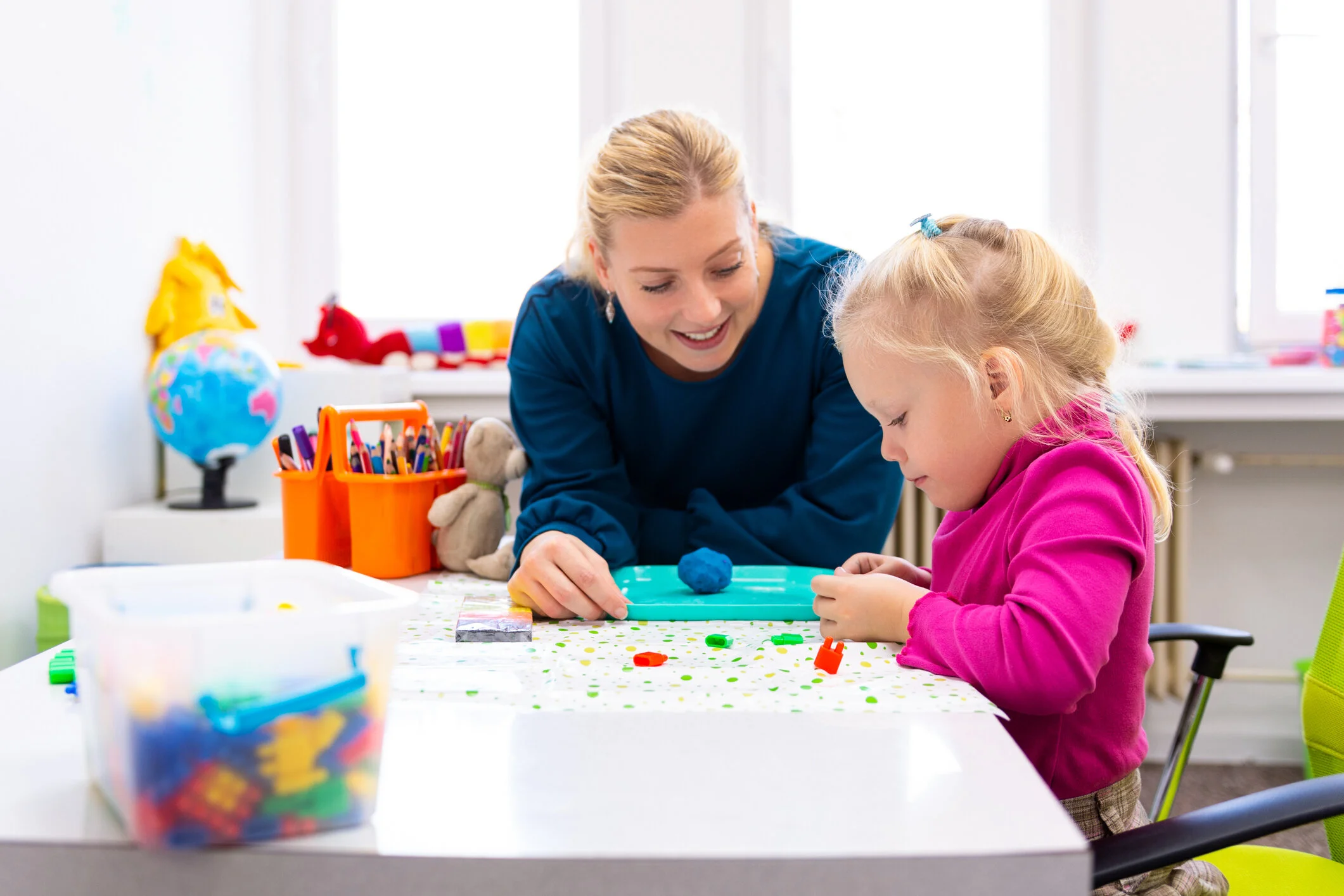
CHILD-CENTERED PLAY THERAPY
WHAT IS PLAY THERAPY?
Play therapy is a counseling approach that allows the counselor to relate to the child in a developmentally-appropriate way. Play therapy is to children what talk therapy is to adults. It is typically utilized with children ages 3-10 and sometimes with older children and adults.
Carefully selected toys are used to help children express their thoughts, feelings, and wishes.
Children are typically unable to fully engage in abstract reasoning until age 11, which makes it difficult for them to use words to describe what they are thinking and feeling. Play is their language; the toys are their words. Play therapy allows children to convey how they feel through the medium of play, which is their natural form of communication versus forcing children to adapt to the natural ways of adults, which is verbalization.
WHY DOES MY CHILD NEED PLAY THERAPY?
To cope with social and emotional issues at home and school, such as disruptive behaviors, divorce, loss of a loved one, abuse, adoption, chronic illness, depression, anxiety, etc. because no child is too young to be affected by the stresses of life
Getting help now can prevent greater problems from developing in the future.
Sometimes it’s easier for children to disclose and explore their emotions with someone outside of their home and school, especially feelings that can be embarrassing, such as fear and anger.
Watch this 1-minute video explaining the rationale of play therapy.
ARE ALL TYPES OF PLAY THERAPY EQUALLY EFFECTIVE?
No, not every play therapy approach is substantiated by evidence, nor have all counselors who call themselves play therapists received adequate training and supervision.
All of our counselors at Restoring Hope Counseling & Consulting, PLLC have undergone extensive training through the world-renowned Center for Play Therapy, and we utilize child-centered play therapy, which is an evidence-based treatment and the most-researched theoretical model of play therapy, with decades of studies to support its efficacy.
A child-centered play therapist provides repeated opportunities in each session for the child to lead, emphasizing the child’s individual agency, helping the child feel empowered and capable of developing self-control in the midst of life circumstances that he/she cannot control.
The goal of the therapist is to fully understand and unconditionally accept the child as he currently is versus trying to fix the child and his problems. “I accept you as you are,” not “I’ll accept you if…” The unique, empathic responses of a properly-trained child-centered play therapist help a child gain self-awareness and feel accepted, which leads to developing a healthy self-confidence and often results in positive outcomes.
RESEARCH TO SUPPORT CHILD-CENTERED PLAY THERAPY:
Click on the following links to read about specific research studies where CCPT has demonstrated statistically significant desirable effects regarding the following issues:
WHAT CAN PARENTS EXPECT FROM PLAY THERAPY?
You will be expected to participate in ongoing parent consultations to receive and provide feedback. The play therapist will be happy to share general impressions and offer suggestions but is not at liberty to tell you the specifics of what your child says or does in the playroom. The therapist will disclose concerns and provide information that is important for you to know.
During the therapy time, all thoughts, feelings, and most actions of the child are accepted, within consistent, clearly defined limits. As the therapist creates an atmosphere of acceptance, without judgment, the child feels safe enough to risk being vulnerable and to fully and freely explore and express himself.
Children are allowed to work through their problems at their own pace according to their individual needs.
Working through issues in play therapy can be painful and emotional. It is common for children to display an increase in acting-out behaviors at home after play therapy sessions. This can be a sign that their time in therapy is being spent productively. It is best to continue therapy until these unwanted behaviors subside.
A child’s behavior is a byproduct of how he feels about himself, so as your child develops a positive view of himself, you will likely notice improvement in your relationship with your child and a decrease in behavior problems.
PREPARING FOR PLAY THERAPY
Play therapy can be messy, so please dress your child in play clothes.
Tell your child that he/she will be coming to a special playroom with a nice grown-up who has a lot of fun toys.
In general terms, briefly explain why he/she is coming. Ex: “Things don’t seem to be going very well for you at home (or school), and sometimes it helps to have a special time and place just for you to share with a special person.”
You may also tell your child that it is OK to talk about anything in the playroom.
The therapist will not pressure the child to disclose information about his/her life or a traumatic incident, so please don’t pressure your child to talk either. A child can heal and change even when unaware that change is occurring.
AFTER EACH SESSION
If your child brings artwork from the session, it is best not to evaluate his/her art either positively or negatively. Avoid offering praise, such as, “That’s beautiful!” Focus on how your child feels about his/her art, and describe what you see, without labeling. Ex: “You covered the page with blue and black marker.” If you praise the painting, she may feel she should make other paintings for you.
Please understand that the time your child spends in play therapy is powerful and not the same as simply playing at home. When asked about his/her therapy sessions, your child may say, “We just played.” This standard response is similar to when children are asked what they learned in school today and universally shrug their shoulders and answer, “Nothing.” Children don’t always recognize when something important has happened.
It is important that your child does not feel pressured to give you an account of what happens in the play therapy room because this could prevent him/her from feeling comfortable enough to participate in certain therapeutic activities or discussions that he/she might find embarrassing to discuss outside of the sessions.
Therapy is a process, and change will occur over time. Therefore, be patient, and trust the process. 😊
8 BASIC LEARNING EXPERIENCES OF CHILDREN IN CHILD-CENTERED PLAY THERAPY
Children learn to respect themselves.
Children learn that their feelings are acceptable.
Children learn to express their feelings responsibly.
Children learn to assume responsibility for themselves.
Children learn to be creative and resourceful in confronting problems.
Children learn self-control and self-direction.
Children gradually learn, at a feeling level, to accept themselves.
Children learn to make choices and to be responsible for their choices.
The above information is adapted from Landreth, Garry L.
Play Therapy: The Art of the Relationship, 3rd Edition. New York, Routledge, 2012
To learn more about the field of play therapy, visit the Association for Play Therapy webiste.
“We are so very grateful for you and the way you have served [our daughter] and our family this summer. We are beyond grateful for the breakthrough the Lord has brought in [her] life and you have played a huge part of that. Thank you so much! You are incredibly gifted at what you do and we are forever grateful! ”
“I hope one day things will change [financially], and we can come to you. It’s very clear from many that you are the best around! ”