
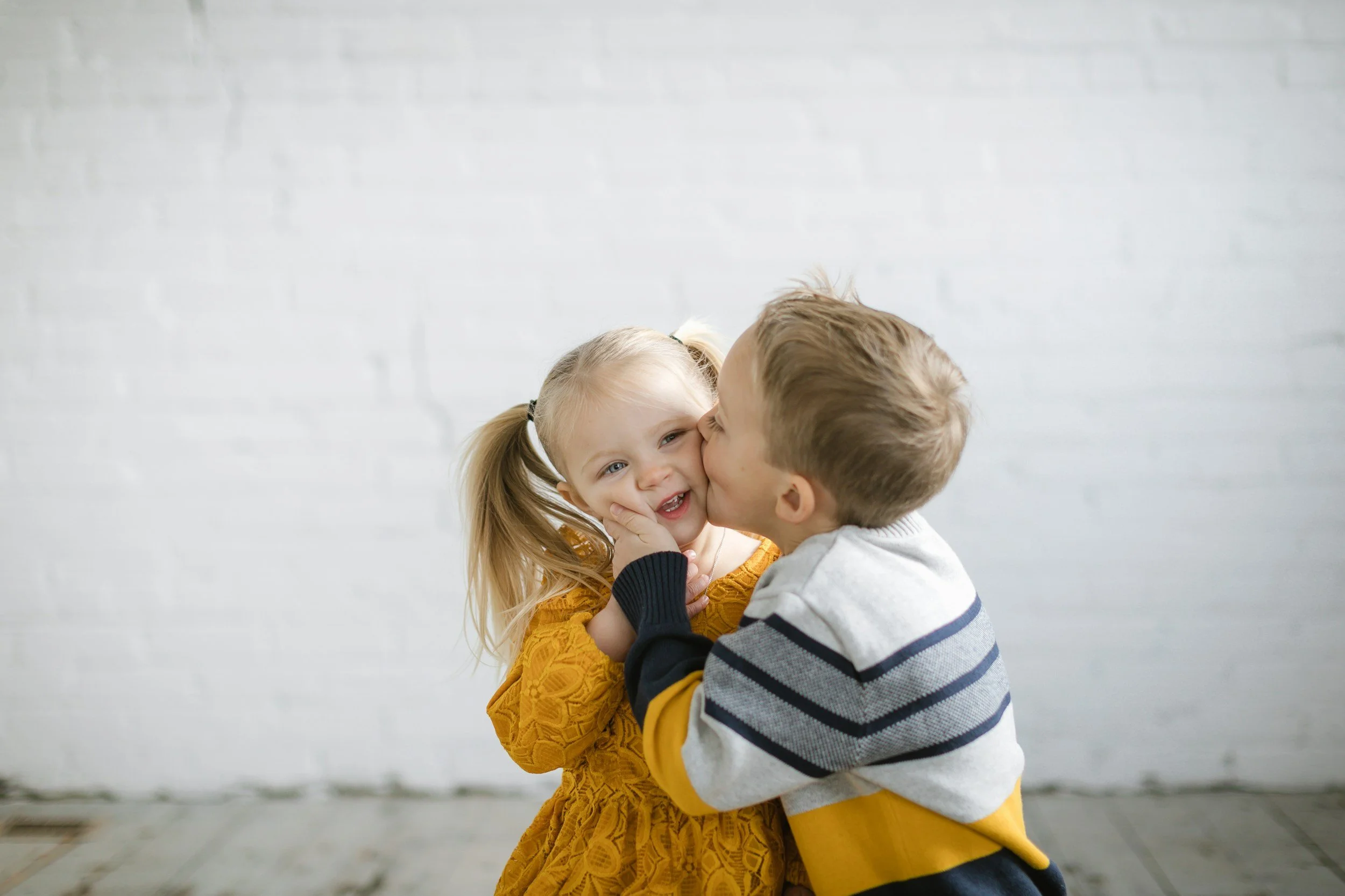
Building a Loving Home: Managing Sibling Rivalry
At Restoring Hope Counseling and Consulting, PLLC, all of our playrooms have a Fisher-Price Loving Family set of doll figures and a Loving Family Dollhouse. When a client comes to a session, these characters are always set up neatly with furniture that matches and fits perfectly and doll children who keep their shoes on at all times. Sometimes, when I see young parents with their children at church, dressed in their Sunday best, I notice similarities between them and these Loving Family Dollhouse characters. But I recognize that raising a family can be very difficult and messy.
Parents frequently bring the issues of sibling rivalry into our parent consultations. In this day and age, building a family based on love, compassion, and connectedness is extremely challenging. In this blog post, we will explore ways parents can foster healthy family dynamics, especially when parenting multiple children under one roof.
Siblings Without Rivalry
Many excellent books and podcasts address the current challenges of parenting; they often note that some behavior challenges in the home stem from the fact that children learn from what is modeled for them. I often tell parents that they are always teaching their children, whether they realize it or not.
Children are also more likely to act out their feelings rather than talk about them. This is because most children up to age 11 cannot fully engage in abstract reasoning. Modeling how to acknowledge the feelings of others, demonstrating self-control, and showing kindness towards others is the role of primary caregivers. We do this so that our children will grow up to be healthy people and good parents for our future grandchildren. There is no better opportunity to practice modeling this than in the home when siblings are fighting.
In 1988, Adele Faber and Elaine Mazlish wrote Siblings Without Rivalry: How to Help Your Children Live Together So You Can Live Too. This excellent book, updated in 2012, gives the reader a bird's-eye view into a 10-week parenting group where parents discuss all types of sibling problems and brainstorm solutions with the help of pertinent lessons taught by the group leaders. It highlights the age-old challenges of helping children get along, while offering caregivers ways to model the behaviors and foster the connectivity they hope to instill in their children. This book includes tips about helping children express their emotions in non-harmful ways, information on setting boundaries, and examples of when parents need to get involved in sibling conflicts. Below is a summary of some of the wisdom this book offers to parents to help their children learn to get along.
“Brothers and sisters need to have their feelings about each other acknowledged.” (p. 45)
Accepting and acknowledging a child’s feelings as valid is the first step in parenting towards a loving family. The authors remind us to put ourselves in our children’s shoes with the following scenario: consider a three-year-old child who is showing anger towards a new baby in the family. Then consider a similar scenario of how you might feel if your spouse brought home an additional partner to live in the home with you. That would be a shocking development, bringing up feelings like anger, jealousy, and betrayal. It is important to acknowledge that the three-year-old with the new sibling is probably feeling similar emotions.
“Children need to be shown how to discharge angry feelings acceptably.” (p. 30)
Hurtful actions need to be stopped; yelling, hitting, and damaging property are not acceptable. Teaching children alternative behaviors at a young age builds habits for handling big feelings. These replacement behaviors could be as simple as helping them communicate their anger with their words by giving them the language to use or directing them to draw a picture or hit a pillow to show the intensity of their anger towards their sibling.
“Children don’t need to be treated equally; they need to be treated uniquely.” (p. 81)
The authors describe many scenarios where fights occur over the idea of fairness. It is clear from several of the stories in the book that if not taught how to manage feelings of jealousy, children will take matters into their own hands. One lady from the parenting group recalls that, as a child, her father called her sister his “princess” because of her long, beautiful hair. She was jealous of her father’s affection. One night, she cut off her sister's hair in her sleep so it would be the same length as hers and they would be equal! A way to address this is to recognize the unique needs of each child and stay attuned to when those needs are challenged or not met.
“Children with problems do not need to be viewed as problem children.” (p. 118)
It is easy to focus on the problems or unwanted behaviors of children. However, through parenting techniques we teach at Restoring Hope Counseling and Consulting, PLLC, parents learn how to accept their children as they are, with their wants, needs, and big feelings. This mindset empowers parents to help children accept their own feelings and have their efforts acknowledged. Sometimes, when siblings have problems, they do need guidance. They are also able to come up with their own solutions when they know their feelings are accepted and appreciated. Parents can provide a safe, secure environment that promotes each child’s growth.
Personal Experience
The last reminder from this book is one I can attest to in my own life. The authors remind us that sibling strife is normal and, when handled correctly, can help children grow into healthy adults with good relationship skills. I homeschooled my three children for much of their childhood, and I can remember getting so exhausted from feeling like a referee. I did what I could to foster a peaceful home where my kids would get along and love each other by following many of the tactics above. Now, my three adult children initiate hanging out or talking on the phone with each other regularly. They share feelings of pride in each other’s accomplishments, support each other through life changes, and show simple kindness to one another. They also still tease each other relentlessly, but in good fun.
When they were growing up, I was not sure of the future outcome. Looking back and talking to them individually, I learned how their experiences with their siblings influenced their ideas and self-images. They each recognized their differences and roles early on and, deep down, had good feelings for each other, despite how they acted towards one another. We did not look like the Fisher-Price Loving Family characters by any means, but my adult kids are truly loving people, and we are a loving family. This positive outcome gives me comfort and hope for other families I work with at Restoring Hope Counseling and Consulting, PLLC.
Faber, A., & Mazlish, E. (2012). Siblings without rivalry: How to help your children live together so you can live too. W.W. Norton & Company, Inc.
If you would like support in your parenting journey, we would love to provide you with empathy while equipping you with research-based parenting skills through our 10-week Child-Parent Relationship Therapy course and/or individual parent consultations. Our therapists currently have openings at Restoring Hope Counseling & Consulting, PLLC in Southlake and would be honored to support you.
Get started here:
https://www.restoringhopedfw.com/contact

Contributed by
Deborah McNary, MA, LPC